By Kelly Baker, Regional Evaluation Associate, AmeriCorps VISTA
On the tail end of their wildly successful Street Food Festival, La Cocina hosted their 3rd Annual Food & Entrepreneurship Conference. Through Women's Initiative's partnership with La Cocina as members of the San Francisco Economic Development Alliance, I was lucky enough to attend the second day of the conference free of charge.
The day was packed with thematic panel discussions around food, technology, and entrepreneurship. In the morning I attended “How to Create Spaces for Successful Entrepreneurship.” The panelists included representatives from Bay Area farmers’ market associations, Josh Assink with Urban Village and Lulu Meyer with the Ferry Plaza Farmers’ Market, as well as Alec W. Bauer of KRBS, Jonny Price of Kiva, and Junette Sheen of CCEDA acted as moderator. During the discussion, panelists and attendees grappled with the issue of barriers to entry: lack of access to affordable kitchen space, discrepancies in health code enforcement, and funding.
For me, one of the most interesting pieces to come out of the discussion was a new program Kiva is launching, Kiva Zip. Earlier in the discussion representatives from the farmers’ markets emphasized the importance of bringing people closer to their food source, the coming together of producer and consumer. Kiva’s new program similarly aims to bridge the gap between lender and borrower. Lenders make small loans of at least $25 to a new venture, ultimately contributing to a loan made at 0% interest to the borrower (at higher risk). Price cited an example in which the borrowers often in turn became part of the customer base for their lenders, stopping by to see how things were progressing and supporting their investment. This program has great potential to foster local enterprise.
After a delicious Nepalese buffet lunch, there was a large panel discussion on Food & Technology, discussing new apps, websites, and social media strategies that food entrepreneurs can take advantage of. Participants then broke out into smaller discussion groups after the panel. I attended the session on “Using Technology to Foster Entrepreneurship in Communities.” In this session led by Joel A. Lacayo of Mission Asset Fund and Amanda Oborne of FoodHub, participants shared challenges and strategies for using technology. Many of us in the room represented nonprofits working to help entrepreneurs, so social media outreach and the digital divide were central issues in the conversation.
All in all, the conference was inspirational and informative. It was a wonderful opportunity to connect with a variety of people, organizations, and entrepreneurs working toward innovative new solutions to problems of economic development and recovery.

Women's Initiative provides high-potential, low-income women with the training, funding and ongoing support to start their own businesses and become financially self sufficient. The women who go through our program significantly increase their income and assets while launching businesses, creating jobs and stimulating the local economy.
We have two urban hubs to serve women throughout the San Francisco Bay Area and are expanding to New York City and Chicago.
Monday, September 10, 2012

Friday, September 7, 2012
Women’s Initiative Graduates “Popping-Up” and Sticking Around
By Nellie Stokeld, Partnership Development Associate, AmeriCorps VISTA
We here at Women’s Initiative for Self-Employment love to brag about the successes of our clients as they start and grow their businesses. That is why we are thrilled to see some of our graduates being recognized for their success and innovation in not one, but two, recent articles on Oaklandlocal.com.
The women featured in these articles are champions in the growing trend literally popping up in Downtown Oakland. Anyka Barber will be celebrating her gallery’s one year anniversary at her new location at 1427 Broadway, called Betti Ono Gallery, at this week’s First Friday Art Murmur. Anyka originally started her business as a pop-up gallery in the Marquee Lofts across from Fox Theater. She said she got the idea to follow the path to entrepreneurship after speaking to her friend and Women’s Initiative graduate, Erica Varize, who owns Evarize Cut And Sew Boutique in Berkeley. Her new gallery, now in a much bigger space, will be shared with yet another Women’s Initiative graduate, Penelope Adibe, owner of Nneka and the former co-owner of the pop-up store OakCollective, in the same 1427 Broadway location. Rachel Konte, who had co-habited the OakCollective pop-up has now opened her own permanent location for Owl N Wood at 45 Grand Ave. Similarly, the article points out several more successful graduates, whose brick and mortars are reaching great success: Bakesale Betty’s Alison Barakat and Telegraph Avenenue’s Shoe Groupie, owned by Dion Bullock and Candice Littlefield.
The list could go on and on about the amount of Women’s Initiative graduates who are bringing energy and life to downtown Oakland; on any given lunch break I can come across four or five of our graduates’ businesses within a short walk from our offices on the corner of 17th and Telegraph. The women featured in these articles, however, are part of a larger trend. Pop-up storefronts are becoming a popular and economically viable alternative to empty storefronts and high barriers to entrance for entrepreneurs. We’re happy to see these women seeking creative solutions to strengthen their businesses and enliven the neighborhood. Be sure to check them out in their new locations and Art Murmur celebrations this Friday!
And now you can find more of our graduates’ businesses in the Orange Pages, our online business directory newly available through our partnership with LocalOn.
Thursday, August 16, 2012
Graduate Spotlight: Maricela Yee's Little Shop Artisan Box
By Amia Grashin, Summer Fellow

 |
| Maricela with her Gourmet Foodie Boxes |
In 2011 Maricela Yee moved to the Bay Area from Hawaii. She always knew that she wanted to help individuals and better the community, but could not figure out what platform would work best for her. Prior to arriving in California she spent time working as a social worker and sold flowers on the streets of Honolulu, but these jobs did not truly fulfill her desire to be a part of a collective and artistic avenue of change.
Leftovers and an attempt to preserve items from farmers markets sparked the initial idea for Little Shop Artisan Box. The spirit of Oakland inspired an idea in Maricela, and Women’s Initiative provided her the tools to turn that idea into a business.

Maricela creates Community Supported Agriculture (CSA)-style boxes of local, gourmet, artisan foods. She experienced the food of Bay Area artisans and wanted to help to share their talents with the community. Little Shop Artisan Box delivers hand picked, themed boxes to subscribers every month. The goal is to tell the stories of the artisans through their food. On the website customers can find stories about where the culinary creations come from. This business is the perfect mix of promoting local artisans, collaborating with people, and enjoying amazing food.
We at Women’s Initiative are extremely proud to have Maricela as part of our family and we look forward to her ongoing success.
Through this experience Maricela has discovered that she loves to empower people and now works to help her vendors grow in a sustainable, positive way. She has developed a business that celebrates each artisan and their craft, while staying local. Maricela is passionate about featuring other budding entrepreneurs, which grows their businesses along with her own. She brings the artisans on board in creating cohesive themes for the boxes. This creative collaboration is something that Maricela loves, and it is something that can be felt and tasted by the customers.
 |
| Foodie Boxes: April Inspired by Spring Flowers; January Spice is Nice; February; Mothers' Day |
She currently works with almost 40 local vendors and provides boxes to over 100 clients every month. Her business has grown so much in its first year that she has had to hire an intern to help her to expand effectively.
Maricela is always looking for way to reach new artisans and help them to build their businesses. She has found that Women’s Initiative can be a great tool in fostering their success. When speaking with Maricela about the success of her business she cant help but come back to the vital role that Women’s Initiative has played in providing her with important knowledge about becoming a successful business owner and providing her continued support as her business grows.
Friday, August 3, 2012
Economic Self Sufficiency vs. Living on the Financial Edge
By Elizabeth Krueger, Summer Fellow (@elizlk)
A recent PBS Need to Know episode paints a vivid portrait of what it means to be “Living on the Financial Edge.” Watch it and see how a working-but-poor family makes difficult trade-offs every day and month, living on $35,000 a year - well above the federal poverty line of less than $20,000 a year for a family of 3. The mother spreads out her medication rather than taking it as prescribed, the older son works all day without lunch, with a paycheck spoken for before it’s even earned. They have no savings and can’t look to the future, needing to devote all their energies to daily juggling.
Women’s Initiative seeks to help low-income women achieve financial self-sufficiency, but what exactly does that mean?
“To be truly economically secure, and leave poverty behind for good, people need enough money to be able to pay for the basics like rent, food, child care, health care, transportation, and taxes, and enough money to develop savings and assets.” Insight Center for Community Economic Development
In considering the situation portrayed on Need to Know, the family income wasn't enough to cover all its food or health care costs, much less the ability to save – and that’s at an income level nearly double that of the federal poverty guidelines. As the Insight Center describes, the federal poverty guidelines don’t reflect a meaningful measure of what it actually costs to live. The calculations don’t consider the costs of rent, child care, transportation or health care. The calculation is based only on the cost of food, which is assumed to be 1/3 of a family’s total cost of living, with no variation by region. Do you think milk, bread and eggs cost the same at a grocery store in San Francisco and Indianapolis? Neither do I.
The Insight Center has an online Self Sufficiency Calculator for California on its website, which paints a better picture of what income would be required for economic self-sufficiency. For San Francisco County, the annual income is around $48,000 for a family of 3 adults – more than $13,000 more than the family in Newark, NJ. And food costs are estimated at less than 1/5 of monthly income, unlike in the federal guidelines. According to the US Census Bureau, which uses the federal poverty guidelines, there were 46.2 million Americans living in poverty in 2010. Imagine how many people live below the much higher standard of true economic self-sufficiency.
For women driven to own their own businesses, Women’s Initiative can help. In addition to teaching women the necessary business skills, Women’s Initiative training covers personal financial literacy skills, similar to some of what was described in the Need to Know program. Women need to know how to avoid the pitfalls of the financial system, generate income and start to build savings to achieve self-sufficiency.
Monday, July 30, 2012
A Win-Win-Win Collaboration – Circle Bank and Women’s Initiative
By Elizabeth Krueger, Summer Fellow (@elizlk)
You may have heard that Women’s Initiative partnered with Circle Bank to make loans to Women's Initiative graduates. Now in its second year, the program is expanding, and is a win for all concerned. Why does this partnership make so much sense?
Under Community Reinvestment Act (CRA) regulations, banks are required to provide a portion of their investments/services to underserved communities in areas where the banks do business. This can range from helping to finance low-income housing projects, to providing low-fee services. Microlending can also meet CRA requirements, but the effort to do underwriting (background & credit checking, and business plan due diligence) can outweigh the small loan amounts, which range from $1,000 to $50,000 currently. (Typical bank loans tend to start at $500,000.) The bank regulatory requirements for tracking the risks of their loan portfolios can also add to costs. These combined underwriting and regulatory costs discourage banks from microlending as part of their CRA activities.
In the Circle Bank partnership, Women’s Initiative is able to offset the underwriting costs. The Women's Initiative financial services team does the necessary work to ensure the borrower meets the agreed underwriting standards, and provides the documentation to Circle Bank. Because Women's Initiative has an existing relationship with the borrowers, the underwriting effort required is lower than if the bank were to do it directly, so the process overall is more efficient.
Through the Circle Bank/Women's Initiative partnership, more Women's Initiative graduates have access to appropriate loans for starting or expanding businesses. This increases the impact of women in their communities and families, helping more women on the way to economic self-sufficiency.
It’s a win-win-win proposition that more banks and microenterprise service providers should consider:
- Circle Bank wins by meeting CRA needs and helping grow its customer base
- Women’s Initiative wins by meeting financing needs of more graduates by providing underwriting at lower costs than banks could
- Women’s Initiative graduates and their communities win by getting access to capital for new and growing businesses, and the positive ripple effects they generate.
Wednesday, July 25, 2012
What does the new California budget bill mean for low-income women?
By Shelley Hughes, Summer Fellow, Women's Initiative
The California budget is a source of ongoing debate, analysis and stress for legislators and Californians alike. Each year the government embarks on a lengthy and complicated journey to develop an annual budget that must get passed by the Super Majority before it is sent to the Governor for final signature.
Last month, Jerry Brown signed the 2012-2013 California state budget bill and outlined a plan to raise $8.5 billion in 2011 – 2013 by increasing personal income tax rates on very-high-income Californians for seven years and raising the state sales tax by one-quarter percent for four years. The Women’s Foundation of California, who launched the “Stand With Women” campaign to challenge budget cuts that would negatively affect women in our state, recently outlined what the signed budget means for low-income women:
The good news:
- Doesn’t cut Cal Grants for public university and college students.
- Doesn’t restructure CalWORKs, the welfare-to-work program that serves 1.4 million poor Californians, 1 million of whom are children.
- Doesn’t lower the market rate reimbursement for child care providers, which would have put many quality providers out of business and had a devastating effect on parents who rely upon them.
- Doesn’t move child care under the Department of Social Services. Child care remains the responsibility of the Department of Education, as it should considering that child care needs to support children’s educational development.
Of concern:
- There are now 26,000 fewer child care slots for needy children, leaving parents with fewer child care options while they’re at work or attending school.
- Time on CalWORKs has been reduced from four years to two. In a difficult economy, two years is rarely enough time for families to establish economic security.
Although the budget is signed, voters must pass the Governor’s ballot measure in November in order for the bill to take effect. If voters reject the measure on Nov 6, the budget agreement would trigger $6 billion in spending cuts that would come into effect January 1, 2013 and primarily affect public school, colleges and universities.
The complete budget summary can be accessed here:
http://www.ebudget.ca.gov/Enacted/BudgetSummary/BSS/BSS.html
Monday, July 23, 2012
Seeing the World Through New Eyes
By Ewelina Salaga, Summer Fellow
With a smile and confidence in their faces, thirty two graduates from Simple Steps and ALAS classes from the San Francisco branch of Women’s Initiative entered the ING Direct Café on July 18th, 2012 to receive their certificates enabling them to start a new chapter in their lives. This certificate confirms their rewarding accomplishment- exciting, fascinating, and challenging at times. These women finished an eleven week program at Women’s Initiative that prepares them to establish their own business, ranging from being a math tutor to a professional health adviser. Not only does the program teach women business plan preparation and break-even point analysis but also, most importantly, confidence, self-esteem, and improved communication skills, so essential in the business world.
Indeed, remarkable achievement was seen when each of the graduates presented their own commercial of their new business. There were a lot of touching moments that show how vital it is to be comfortable speaking in public. Some women wouldn’t have been able to do it 11 weeks ago but with the Women’s Initiative program, the graduates were able to overcome obstacles. With a different level of confidence and sometimes with a little help in the form of a note, all the graduates proved that they felt comfortable in their skins and at the end they shone on the stage.
Throughout the ceremony valuable advice was given by the speakers. As Adriana Lahl, one of the previous graduates of the Women’s Initiative program currently running her own business said, by working hard, paying bills on time, improving their credit score, the graduates will get what they want to get so success is in their hands. Also, she reminded the graduates to continually invest in clients, training, and consulting. At the end, Nicole Levine, the executive director of Women’s Initiative, summarized the ceremony by highlighting importance of staying connected with Women’s Initiative and being an active member of the SuccessLink Program that connects people and businesses.
After the ceremony all the proud graduates with their families and friends mingled together around a cake and appetizers to talk about their future plans, plans that are exciting and the graduates look forward to realizing. Certainly, with greater confidence, competence, and belief in them, the graduates from now on will perceive the world through new eyes, more bright and colorful.
 |
| Graduates of the San Francisco ALAS class with their certificates and trainer Sandra Murillo (left) |
With a smile and confidence in their faces, thirty two graduates from Simple Steps and ALAS classes from the San Francisco branch of Women’s Initiative entered the ING Direct Café on July 18th, 2012 to receive their certificates enabling them to start a new chapter in their lives. This certificate confirms their rewarding accomplishment- exciting, fascinating, and challenging at times. These women finished an eleven week program at Women’s Initiative that prepares them to establish their own business, ranging from being a math tutor to a professional health adviser. Not only does the program teach women business plan preparation and break-even point analysis but also, most importantly, confidence, self-esteem, and improved communication skills, so essential in the business world.
 |
| Proud grads share their business pitches with confidence |
Throughout the ceremony valuable advice was given by the speakers. As Adriana Lahl, one of the previous graduates of the Women’s Initiative program currently running her own business said, by working hard, paying bills on time, improving their credit score, the graduates will get what they want to get so success is in their hands. Also, she reminded the graduates to continually invest in clients, training, and consulting. At the end, Nicole Levine, the executive director of Women’s Initiative, summarized the ceremony by highlighting importance of staying connected with Women’s Initiative and being an active member of the SuccessLink Program that connects people and businesses.
After the ceremony all the proud graduates with their families and friends mingled together around a cake and appetizers to talk about their future plans, plans that are exciting and the graduates look forward to realizing. Certainly, with greater confidence, competence, and belief in them, the graduates from now on will perceive the world through new eyes, more bright and colorful.
 |
| It's a family affair! |
Thursday, July 19, 2012
Oakland Connect Event Recap
By Kendall Warson, Women’s Initiative Intern 
Michael C. Bush (right) and Ian Philabaum (left) at the Connect Event
Last night in Preservation Park in Oakland, Success Link Specialist Ian Philabaum organized a highly informative, fun, and engaging Connect Event for Women’s Initiative. The organization holds such events to support graduates in maintaining a strong and successful business through the inevitable ups and downs they face.
Yesterday evening, Michael C. Bush was invited to speak to graduates and supporters of the program. Michael was born with an intuitive interest in business. He has an impressive resume, having taught at Stanford and Mills colleges. He also founded Inner City Advisors, a non-profit organization which focuses on creating jobs in urban areas. Specifically, he teaches an “8 Factors Framework” which he spoke about last night in tandem with the subject of “Intelligent Risk Taking”. His words were real; he truly confronted the issues and challenges that small business owners face. Ultimately, by having a strong mission and core business values, Michael believes taking risks is the true key to advancing one’s business. He presented a challenge: to confront one’s fear and step past it.
After Michael spoke, the attendees at the event did activities at their respective tables. Graduates and connectors (volunteer business leaders from the community) identified risks they had taken in the past. Furthermore, the groups discussed personal business issues. Each business owner explained the risk they would need to take to overcome the problem. At the end of the discussion, everyone was able to share whether or not they felt it would be an “intelligent” risk for the small business owner to take.
The event was not only entertaining to attend, but empowering to be a participant in. Michael’s words spoke candid truths about risk and he was able to inspire graduates as well as connectors to empower themselves to make thoughtful changes which may have uncertain results. The entire night was a complete success and a played out harmoniously.
Michael C. Bush (right) and Ian Philabaum (left) at the Connect Event
Last night in Preservation Park in Oakland, Success Link Specialist Ian Philabaum organized a highly informative, fun, and engaging Connect Event for Women’s Initiative. The organization holds such events to support graduates in maintaining a strong and successful business through the inevitable ups and downs they face.
Yesterday evening, Michael C. Bush was invited to speak to graduates and supporters of the program. Michael was born with an intuitive interest in business. He has an impressive resume, having taught at Stanford and Mills colleges. He also founded Inner City Advisors, a non-profit organization which focuses on creating jobs in urban areas. Specifically, he teaches an “8 Factors Framework” which he spoke about last night in tandem with the subject of “Intelligent Risk Taking”. His words were real; he truly confronted the issues and challenges that small business owners face. Ultimately, by having a strong mission and core business values, Michael believes taking risks is the true key to advancing one’s business. He presented a challenge: to confront one’s fear and step past it.
After Michael spoke, the attendees at the event did activities at their respective tables. Graduates and connectors (volunteer business leaders from the community) identified risks they had taken in the past. Furthermore, the groups discussed personal business issues. Each business owner explained the risk they would need to take to overcome the problem. At the end of the discussion, everyone was able to share whether or not they felt it would be an “intelligent” risk for the small business owner to take.
The event was not only entertaining to attend, but empowering to be a participant in. Michael’s words spoke candid truths about risk and he was able to inspire graduates as well as connectors to empower themselves to make thoughtful changes which may have uncertain results. The entire night was a complete success and a played out harmoniously.
Realities and Potentialities in Gender Equity

Alicia Robb of the Kauffman Foundation of Entrepreneurship wrote a recent post for the Forbes blog entitled "Women: It's Time to Own Your Potential." This title represents the juxtaposition of challenge and promise that women entrepreneurs embody.
As Robb describes, there is much work to be done towards gender equity in the business world. "Women own less than 30 percent of all businesses and only 16 percent of businesses with paid employees," Robb states, and "Women-owned firms generate just 4 percent of total revenues, 6 percent of employment, and 4.5 percent of payroll." Robb also links to a Kauffman Foundation video sketchbook which presents additional statistics about the success gaps between men- and women-owned businesses: women-owned businesses are growing more slowly and have less access to networks of capital than men-owned businesses, for example.
Robb's post reminded me of Anne-Marie Slaughter's controversial article published this month in the Atlantic Monthly, called "Why Women Still can't Have It All." Slaughter's article deals more with the stories of women in positions of political authority, rather than exclusively women entrepreneurs, but there are many connections between the struggles and realities of women in these overlapping categories. There are unique challenges for women working to succeed in business, political, and academic positions that men in similar positions do not face. Slaughter's article calls out cultural concepts of time, family values, and the arc of a successful career, among others, as some of these unique challenges. Robb points to a lack of female presence in investor networks and on boards of directors as others.
These articles do a good job of presenting the realities of women's empowerment today. They do not sugarcoat the situation: clearly, there is much work to be done to bring about greater gender equity in business, academic, political, and cultural worlds. This is why organizations like Women's Initiative are so important. Through the Simple Steps and SuccessLink programs, women from a variety of low-income backgrounds are empowered to enter the business world with the support of knowledgeable staff, experienced alumnae, and professional networks. For example, through Connect Events, Women’s Initiative alumnae can network with successful business professionals as potential investors and advisors who can help them grow their businesses in a number of ways. Through connections such as these, Women’s Initiative programs help narrow the gap between growth rates of men- and women-owned businesses.
Tuesday, July 17, 2012
The Fight for Food: SNAP Benefits & Spending Cuts
By Kelly Baker, Regional Evaluation Associate VISTA
"It is hard to believe that in 2012 we are debating feeding people.”
The hard-hitting final words of Congresswoman Barbara Lee truly strike a chord, considering that the amount of people living under the poverty line has risen to an all-time high, with 46.2 million people living in poverty in 2010.
Last week, the congresswoman said these words arguing against the proposed new farm bill in the House of Representatives, which proposes $35 billion in spending cuts, including $16.5 billion from the Supplemental Nutritional Assistance Program (SNAP or, more informally, food stamps). By eliminating “categorical eligibility”, 2 to 3 million people would no longer qualify for the program.
Unquestionably, SNAP benefits are critical in keeping millions of our citizens out of extreme poverty. In a two-part blog post on the outcomes of the SNAP program, Stacy Dean cites a study from the National Poverty Center: “Counting SNAP benefits as income reduces the number of households in extreme poverty in 2011 from 1.46 million to nearly 800,000, the study found (see graph). And it reduces the number of children in extreme poverty in 2011 by half — from 2.8 million to 1.4 million.”
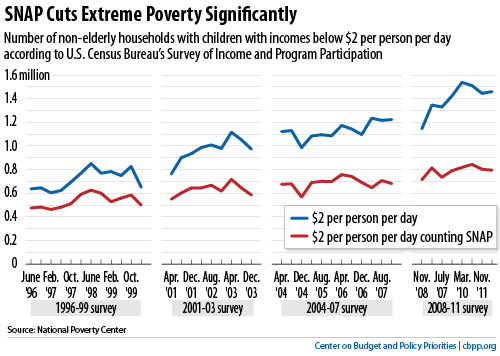
About 14% of Women’s Initiative clients first come through our doors dependent upon public assistance. Moreover, 20% of our clients are low-income single mothers and single-mother households have a 31.6% poverty rate, as compared to a 6.2% poverty rate for families headed by a married couple. Many opponents of government assistance programs posit that such programs perpetuate a cycle of dependence. However, we have seen at Women’s Initiative that by providing specialized training and space for personal growth and empowerment, even some of the neediest welfare recipients can become self-sufficient and provide for themselves and their families. In fact, just 12 months after training, only 12% of our clients are still receiving assistance and two years out that number drops to 8%. Additionally, the average amount of benefits received decreases from $575 to $391 after one year, and further reduced to an average of $266 two years after training. Thus, not only do our clients manage to decrease the amount of benefits they receive, but many are able to get off of them entirely.
Food assistance is a fundamental resource for many of our clients as well as the volunteers at Women’s Initiative. Personally, as an AmeriCorps VISTA member, I know that many of my fellow volunteers would not be able to make the full-time commitment to our organization and others like us without this vital supplement to our modest living stipend.
Thank you, Congresswoman Lee, for fiercely defending an essential program for our community.
Of course, government assistance programs continue to be a hotly debated topic (just take a look at the comments left on the congresswoman’s Facebook post). What are your thoughts? Do you agree with the congresswoman's argument?
Subscribe to:
Posts (Atom)