Showing posts with label economic recovery. Show all posts

Tuesday, September 25, 2012

Spread the word: Starting a business is job creation.

By Shelley Hughes, Summer Fellow


“If one in three microbusinesses were to hire a single employee, the U.S. economy would achieve full employment.“
– Association for Enterprise Opportunity (AEO)

Job creation remains a hot topic in this year’s presidential election as our nation continues to tackle the unemployment crisis. At Women’s Initiative we are well aware of how microbusiness development can positively affect job growth and job creation. After all, within five years of graduating from Women’s Initiative, our clients create an average of 2.5 jobs for others.

So how can we keep track of policy issues that will keep entrepreneurs top of mind when politicians talk about job creation? Thankfully the Association for Enterprise Opportunity (AEO) makes it their mission to keep us informed on relevant issues as they advocate for policy change to support entrepreneurs.

AEO lists the following legislative proposals as key initiatives they are supporting this summer:

  • The Microenterprise and Youth Entrepreneurship Development Act (H.R. 2809), introduced by Rep. Cedric Richmond (D-LA), would strengthen the SBA’s PRIME Program and create one single access point for information on the government’s business assistance programs.
  • The Entrepreneur Startup Growth Act (H.R. 3571), introduced by Rep. Judy Chu (D-CA), would provide grants to nonprofit microbusiness development organizations to provide tax preparation services to disadvantaged and underserved entrepreneurs.
  • The Entrepreneur Access to Capital Act (H.R. 2930/S.1970), the “Crowdfund Act” would ease and simplify reporting requirement for small value investors for certain crowdfunded securities in small businesses.

Interested in helping push for this legislation? This summer the AEO released an advocacy toolkit that outlines how individuals and organizations can take part in the dialogue. Best practices and tips for engaging with elected officials is covered in more detail in AEO’s Engage and Empower Toolkit, which can be found here.

Wednesday, July 25, 2012

What does the new California budget bill mean for low-income women?

By Shelley Hughes, Summer Fellow, Women's Initiative

The California budget is a source of ongoing debate, analysis and stress for legislators and Californians alike. Each year the government embarks on a lengthy and complicated journey to develop an annual budget that must get passed by the Super Majority before it is sent to the Governor for final signature.  

Last month, Jerry Brown signed the 2012-2013 California state budget bill and outlined a plan to raise $8.5 billion in 2011 – 2013 by increasing personal income tax rates on very-high-income Californians for seven years and raising the state sales tax by one-quarter percent for four years.  The Women’s Foundation of California, who launched the “Stand With Women” campaign to challenge budget cuts that would negatively affect women in our state, recently outlined what the signed budget means for low-income women:

The good news:
-          Doesn’t cut Cal Grants for public university and college students.
-          Doesn’t restructure CalWORKs, the welfare-to-work program that serves 1.4 million poor Californians, 1 million of whom are children.
-          Doesn’t lower the market rate reimbursement for child care providers, which would have put many quality providers out of business and had a devastating effect on parents who rely upon them.
-          Doesn’t move child care under the Department of Social Services. Child care remains the responsibility of the Department of Education, as it should considering that child care needs to support children’s educational development.

Of concern:
-          There are now 26,000 fewer child care slots for needy children, leaving parents with fewer child care options while they’re at work or attending school.
-          Time on CalWORKs has been reduced from four years to two. In a difficult economy, two years is rarely enough time for families to establish economic security.

Although the budget is signed, voters must pass the Governor’s ballot measure in November in order for the bill to take effect. If voters reject the measure on Nov 6, the budget agreement would trigger $6 billion in spending cuts that would come into effect January 1, 2013 and primarily affect public school, colleges and universities.

The complete budget summary can be accessed here:
http://www.ebudget.ca.gov/Enacted/BudgetSummary/BSS/BSS.html

Tuesday, July 17, 2012

The Fight for Food: SNAP Benefits & Spending Cuts

By Kelly Baker, Regional Evaluation Associate VISTA

"It is hard to believe that in 2012 we are debating feeding people.”


The hard-hitting final words of Congresswoman Barbara Lee truly strike a chord, considering that the amount of people living under the poverty line has risen to an all-time high, with 46.2 million people living in poverty in 2010.

Last week, the congresswoman said these words arguing against the proposed new farm bill in the House of Representatives, which proposes $35 billion in spending cuts, including $16.5 billion from the Supplemental Nutritional Assistance Program (SNAP or, more informally, food stamps). By eliminating “categorical eligibility”,
2 to 3 million people would no longer qualify for the program.

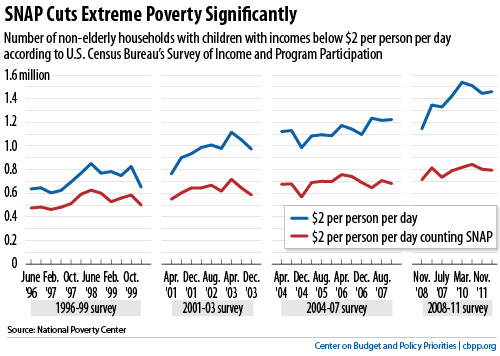
Unquestionably, SNAP benefits are critical in keeping millions of our citizens out of extreme poverty. In a
two-part blog post on the outcomes of the SNAP program, Stacy Dean cites a study from the National Poverty Center: “Counting SNAP benefits as income reduces the number of households in extreme poverty in 2011 from 1.46 million to nearly 800,000, the study found (see graph).  And it reduces the number of children in extreme poverty in 2011 by half — from 2.8 million to 1.4 million.”


About 14% of Women’s Initiative clients first come through our doors dependent upon public assistance. Moreover, 20% of our clients are low-income single mothers and single-mother households have a 31.6% poverty rate, as compared to a 6.2% poverty rate for families headed by a married couple. Many opponents of government assistance programs posit that such programs perpetuate a cycle of dependence. However, we have seen at Women’s Initiative that by providing specialized training and space for personal growth and empowerment, even some of the neediest welfare recipients can become self-sufficient and provide for themselves and their families. In fact, just 12 months after training, only 12% of our clients are still receiving assistance and two years out that number drops to 8%. Additionally, the average amount of benefits received decreases from $575 to $391 after one year, and further reduced to an average of $266 two years after training. Thus, not only do our clients manage to decrease the amount of benefits they receive, but many are able to get off of them entirely.

Food assistance is a fundamental resource for many of our clients as well as the volunteers at Women’s Initiative. Personally, as an
AmeriCorps VISTA member, I know that many of my fellow volunteers would not be able to make the full-time commitment to our organization and others like us without this vital supplement to our modest living stipend.

Thank you, Congresswoman Lee, for fiercely defending an essential program for our community.

Of course, government assistance programs continue to be a hotly debated topic (just take a look at the comments left on the congresswoman’s
Facebook post). What are your thoughts? Do you agree with the congresswoman's argument?